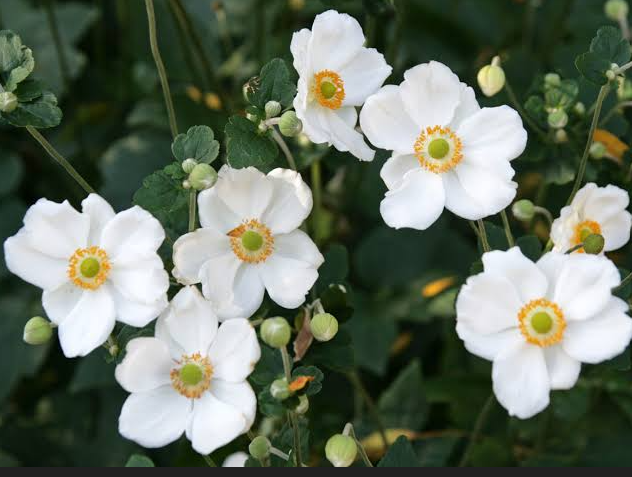
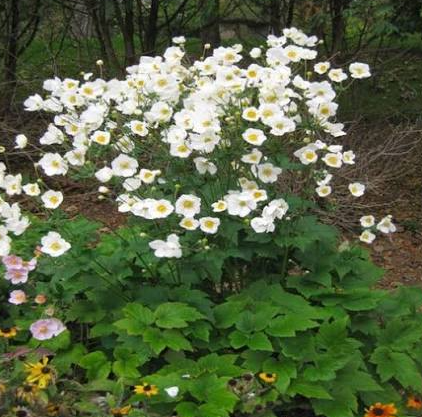
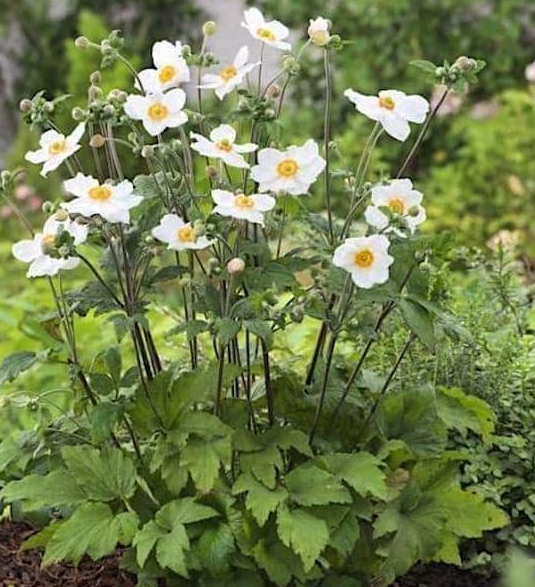
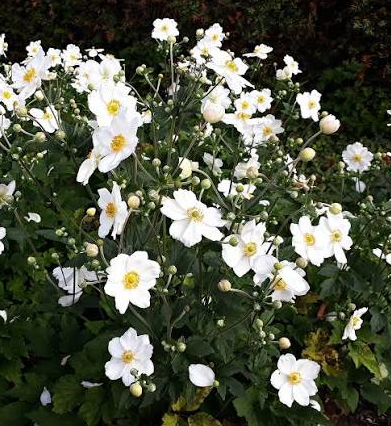
When gardeners talk about plants that shine in late summer and early autumn, Anemone x hybrida ‘Honorine Jobert’ is almost always part of the conversation. Its pure white flowers appear to float above dark green foliage on tall, airy stems, bringing brightness and movement to the landscape just as many other perennials begin to decline.
Often called the Japanese Anemone or Windflower, ‘Honorine Jobert’ has become a staple of cottage gardens, woodland gardens, and perennial borders throughout Ontario and much of North America.
History and Origins
Despite its common name, Japanese Anemones are actually native to China and were cultivated in Japan for centuries before being introduced to European gardens.
‘Honorine Jobert’ itself has a fascinating history. It was discovered as a sport (a naturally occurring mutation) in Verdun, France, in 1858, where it was selected for its striking pure white flowers. Since then, it has become one of the most widely grown Japanese Anemones in the world.
Its enduring popularity has earned it numerous accolades, including the prestigious Royal Horticultural Society Award of Garden Merit and recognition as the 2016 Perennial Plant of the Year by the Perennial Plant Association.
Why ‘Honorine Jobert’ Is Such a Great Plant
We consider ‘Honorine Jobert’ to be one of the finest white-flowering perennials available. Here’s why:
- Exceptional Late-Season Colour
Few perennials provide such a dramatic display from August through October. Its bright white flowers illuminate the garden when many summer bloomers have finished.
- Elegant, Airy Appearance
The blooms dance on wiry stems that sway gracefully in the breeze, creating movement and softness in the landscape. This characteristic is one reason it is often called a Windflower.
- Shade Tolerance
Unlike many flowering perennials, ‘Honorine Jobert’ performs beautifully in partial shade, making it invaluable for brightening woodland gardens and shaded borders.
- Long Bloom Period
The flowers can continue for five to eight weeks or longer under favourable conditions, providing outstanding seasonal value.
- Pollinator Friendly
Bees and butterflies are attracted to the open flowers, adding ecological value to the garden.
- Deer and Rabbit Resistance
Although no plant is completely immune, ‘Honorine Jobert’ is generally avoided by deer and rabbits, a major advantage for many Ontario gardeners.
Landscape Uses in Ontario
Ontario gardeners face the challenge of creating interest throughout the growing season. ‘Honorine Jobert’ excels because it fills the late-summer and autumn colour gap.
Woodland Gardens
The bright white flowers stand out beautifully against darker backgrounds such as evergreens, fences, or mature trees.
Perennial Borders
Plant it toward the middle or rear of borders where its 90–120 cm (3–4 ft.) flower stems can rise above neighbouring plants.
Cottage Gardens
Its informal habit complements classic cottage-garden favourites such as phlox, echinacea, asters, and ornamental grasses.
Naturalized Plantings
Given time, ‘Honorine Jobert’ spreads gently through rhizomes, forming attractive colonies.
Companion Plants
Some of its best companions include:
- Hosta
- Ferns
- Astilbe
- Heuchera
- Ornamental grasses
- Hydrangeas
- Phlox
The white flowers create a striking contrast with the golds, oranges, and reds of the autumn garden.
Growing and Care Tips
Hardiness
‘Honorine Jobert’ is hardy in Zone 4–8, making it well-suited to most of Ontario.
Light
- Full sun in cooler locations with adequate moisture.
- Partial shade is ideal in many Ontario landscapes.
Soil
For best performance, provide:
- Rich, organic soil
- Even moisture
- Good drainage
Avoid letting plants dry out completely during summer.
Watering
Consistent moisture encourages vigorous growth and abundant flowering. A layer of mulch helps retain soil moisture and moderate soil temperatures.
Maintenance
- Cut flower stems back after frost.
- Remove old foliage in spring.
- Divide congested clumps every few years if desired.
Interesting Facts
- The cultivar is over 160 years old and remains one of the most popular Japanese Anemones ever introduced.
- It is sometimes sold under the synonym Anemone x hybrida ‘Alba’, though ‘Honorine Jobert’ is the accepted cultivar name.
- The genus name Anemone is derived from the Greek word anemos, meaning “wind.”
- Once established, plants can slowly naturalize into beautiful colonies through underground rhizomes.
- The pure white flowers often appear to glow in evening light, making them particularly valuable in gardens designed for twilight enjoyment.
Final Thoughts
If you’re searching for a perennial that combines elegance, reliability, pollinator value, and outstanding late-season colour, Anemone x hybrida ‘Honorine Jobert’ is hard to surpass. Its luminous white blooms, shade tolerance, and long flowering season have made it a favourite of gardeners since 1858. Whether planted in a woodland garden, mixed border, or cottage garden setting, this timeless Japanese Anemone continues to prove why it remains one of the most treasured perennials for Ontario landscapes.